WILL: Can This AI Robot Cat Become a Real Companion — or Just Another Smart Toy?
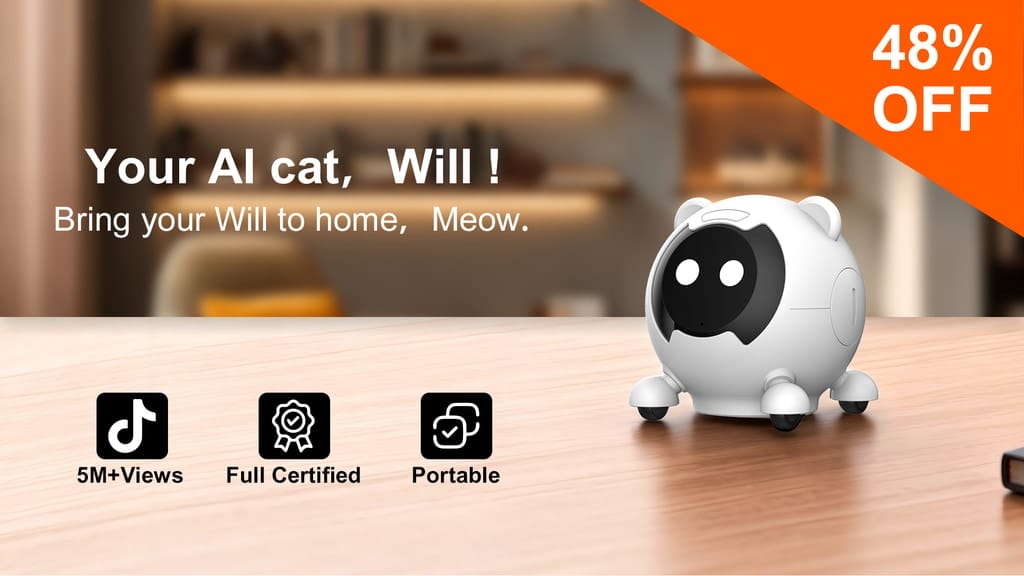
Most Kickstarter robot campaigns sell one fantasy. WILL tries to sell two.
First, it wants to be useful for cat owners: a robot that can keep real cats engaged when their humans are busy. Second, it wants to be emotionally useful for humans: an expressive, personality-driven companion with local AI behavior that feels more present than a voice assistant living inside a phone.
That combined pitch is exactly why WILL is interesting — and why it deserves more scrutiny than the average “cute gadget” campaign.
What WILL is really promising
From the live campaign material, WILL positions itself as an edge-AI robot cat that can respond to voice and interaction without depending on constant cloud processing. The creator frames this as a privacy win: fewer data concerns, less always-online dependency, and a product that can behave more like an object in your home than a service that only works when connected to somebody else’s server.
On top of that, WILL claims cat-focused interaction behaviors (including autonomous engagement modes), emotional expression, and a personality that evolves over time. If that stack works in the real world, it would put WILL in a valuable middle category: not just a pet toy, not just a chatbot with a shell, but a hybrid companion product with practical household use.
The execution challenge is that each layer multiplies complexity. It isn’t enough for WILL to “move” and “respond.” It needs to be mechanically durable, behaviorally non-repetitive, and emotionally believable over repeated daily use. That’s where many companion robots lose users: not on day one, but by week three.

Confidence check: what looks strong vs what is still soft
To keep this grounded, here’s the confidence framework we’d use as backers.
AI/offline privacy positioning: High confidence. The architecture claim is plausible and aligned with where consumer AI hardware is moving. Edge processing as a privacy and responsiveness strategy makes technical sense.
Hardware durability and reliability: Medium confidence. The campaign narrative discusses durability and materials, but we still don’t have broad third-party stress data in home conditions (pet claws, bumps, long-session wear, charging routine realities). Please note that this area has low certainty due to the lack of independent verification. TODO: Add more details if available.
Cat-interaction effectiveness: Low-to-medium confidence. This is the most important and least independently verified part. Getting authentic cat engagement is hard. Cats are unpredictable, and interaction quality often degrades once novelty drops. There is significant uncertainty in this area as well.
Shipping/timeline confidence: Medium-low confidence. The campaign acknowledges normal hardware risks (components, factory scheduling, logistics). That transparency is a plus — but these are still meaningful execution dependencies.
Put differently: the product thesis is credible, but proof of consistency is still in-progress.
Where WILL fits in the market
WILL is entering a category that’s active but still unsettled. There are already products that do pieces of this puzzle: programmable robot cats, emotional comfort bots, and mainstream AI pet robots with bigger distribution. What’s less common is the exact blend WILL is attempting: cat-owner utility + emotional companionship + privacy-forward local AI identity.
That’s potentially a smart wedge. If it works, WILL is not competing only on novelty — it’s competing on fit for a specific user: people who want a home companion object that feels less clinical than a smart speaker and more active than a passive animatronic comfort product.
But that positioning also creates risk: if either side under-delivers (cat utility or emotional quality), users may default to alternatives that do one job better and with less uncertainty.

Value reality: what you’re paying for (and what can change the value)
With Kickstarter products, sticker price is only part of the decision. You’re buying into a bundle that includes product ambition, delivery risk, support uncertainty, and timeline patience. For WILL specifically, the value proposition is strongest if you care about its exact combination of features (cat-focused interaction + emotional companion framing + offline privacy story).
If that combination is not central for you, alternatives available now can offer higher certainty per pound/dollar spent — especially once landed costs (shipping + VAT/customs + regional fees) are factored in.
So the real value test is this: are you paying for immediate reliability, or are you paying for a specific future product identity that doesn’t quite exist in retail yet?
Alternatives that matter — and how they actually compare
- MarsCat (Elephant Robotics) — MarsCatMarsCat is better for users who want a more established robotics ecosystem and a platform-like feel. It skews stronger toward tinkerers, makers, and people who want a robot they can treat like a technical object. WILL looks better if you care less about platform flexibility and more about emotional framing and privacy-forward consumer experience.
- Maicat — MaicatMaicat is better if your center of gravity is learning, smart-home adjacent use, and education-style experimentation. WILL is better if your center of gravity is companionship-first behavior and a less technical day-to-day interaction model.
- Loona (KEYi) — LoonaLoona is better on mainstream availability and lower uncertainty: you can buy into an existing consumer path now. WILL could be better for users specifically drawn to the cat-targeted interaction angle and the local-AI privacy narrative.
- Moflin (CASIO) — MoflinMoflin is better for soft emotional-comfort companionship and brand trust. It’s a cleaner emotional-product story. WILL can be better if you want more active behavior and pet-interaction ambition, not just soothing presence.
- Joy for All Companion Cat — Joy for AllJoy for All is better for low-friction therapeutic companionship and immediate retail certainty, especially in senior-care contexts. WILL is better only if you want AI-forward interactivity and are willing to accept Kickstarter-stage uncertainty.
The key pattern: alternatives often win on certainty and distribution; WILL wins on a specific integrated vision that is promising but still being validated.
Final decision: back now, wait, or buy an alternative?
Back now if... you’re an early adopter, you value WILL’s exact feature mix, and you’re comfortable treating this as a high-upside but execution-sensitive Kickstarter bet. Back this project on Kickstarter
Wait if... you like the concept but want stronger proof on real-cat interaction quality, firmware maturity, and production readiness before committing. There is significant uncertainty here, so waiting for more concrete information might be prudent.
Buy an alternative now if... your priority is dependable experience immediately, with lower delivery risk and clearer post-purchase support pathways.
Our critical read at this stage: WILL has a genuinely differentiated concept and a credible directional thesis. What it does not yet have, in independently verifiable form, is enough real-world evidence to move from “promising” to “reliable.” That doesn’t make it a bad back — it makes it a selective one.
If the team can convert story into proof through updates (demonstrated behavior consistency, production milestones, and software stability), WILL could become one of the more interesting companion products in this niche. Until then, it remains a high-potential, medium-to-high risk campaign.
Affiliate disclosure: This article may include affiliate links. We may earn a commission at no extra cost to you.